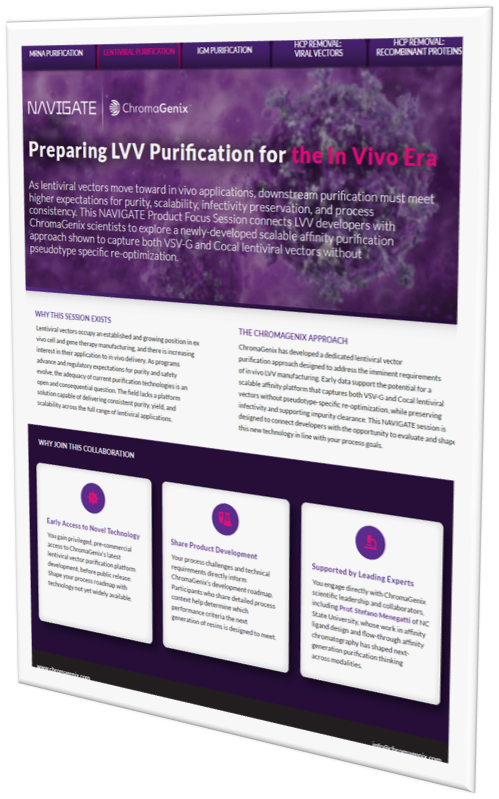
Explore a newly-developed scalable affinity purification approach shown to capture both VSV-G and Cocal lentiviral vectors withoutpseudotype specific re-optimization.
Ligand design & binding affinity: Kᴅ data confirming selectivity for VSV-G (Ligand C) and Cocal (Ligand B) envelope proteins.
Dynamic binding capacity vs commercial resin: Capacity across low- and high-titer feeds, with transducing-unit capacity among the highest reported for any LVV affinity format.
Membrane format performance: Peptide-functionalized cellulose membranes at 0.5 min residence time delivering 90% transducing yield.
Mature virion enrichment: SEC-MALS and electron / fluorescence microscopy confirming transduction-competent particles enriched in the eluate.
PROGRAM CHAIR
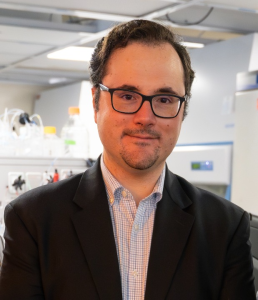
Professor Stefano Menegatti
NORTH CAROLINA STATE UNIVERSITY | CHROMAGENIX
Why this session exists
Lentiviral vectors hold an established, growing role in ex vivo cell and gene therapy, with rising interest in in vivo delivery. As programs advance and regulatory expectations for purity and safety evolve, the field lacks a platform solution able to deliver consistent purity, yield and scalability across the full range of LVV applications.
The ChromaGenix approach
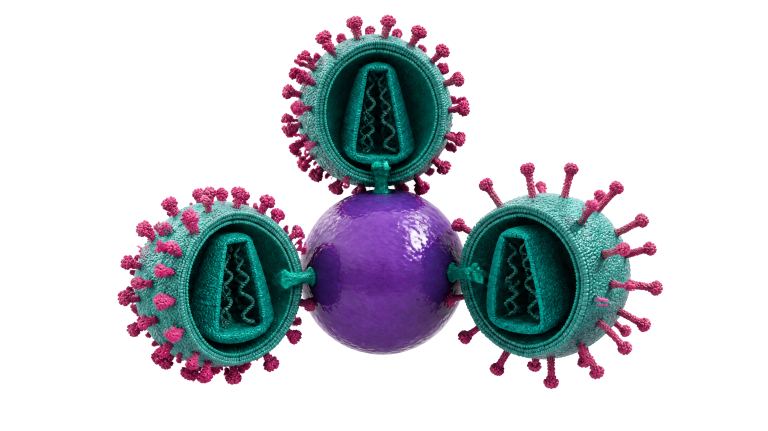
ChromaGenix has developed a dedicated LVV purification approach for the requirements of in vivo manufacturing. Its synthetic peptide ligands are selected against conserved viral matrix epitopes rather than the variable envelope — enabling consistent capture of both VSV-G and Cocal vectors, mild pH elution and preserved infectivity, without pseudotype-specific re-optimization.
Data Demonstrates That One Platform Can Captures Both VSV-G and Cocal
The following key conclusions were drawn from peer-reviewed studies conducted at ChromaGenix and NC State University.
Cross-pseudotype capture from a single resin
Binding affinity data show ligand selectivity for both VSV-G and Cocal without re-optimization of resin format, elution conditions or process parameters.
Transduction competence preserved after mild elution
Functional transduction assay and RT-qPCR titer confirm active, potency-retaining vector recovered across both pseudotypes with no measurable loss of activity.
DBC exceeds commercial affinity resin benchmarks
2–8 × 10¹⁰ vp/mL across feed titers versus 9.73 × 10⁹ for the commercial comparator. Higher throughput per column volume, less resin at scale.
Process robustness meets GMP multi-cycle needs
50-cycle stability at 0.5 M NaOH confirms resin integrity after repeated alkaline CIP, with maintained HCP clearance (LRV >2.2).
Review emerging technology direction before release.
Direct product input
Help define the performance thresholds, process conditions, analytical readouts and GMP-readiness expectations that would make a future product useful.
Scientist-led discussion
Engage with ChromaGenix technical teams on the process problem, not a generic sales pitch.
Potential evaluation pathway
Where there is technical fit, discussion may progress toward deeper data review, Product Focus Group participation, prototype evaluation or collaboration.
What you can expect
01
Scoping conversation
A brief discussion to confirm fit, context and the scientific value of collaboration.
02
Defined collaboration
A structured technical discussion with ChromaGenix process scientists, grounded in your process context to identify constraints and potential solutions.
03
Ongoing development
Continued engagement to support development, testing and refinement toward a better purification solution, shaped by what you have shared.
Why wait for better purification tools when you can help shape them?
Join NAVIGATE as an early adopter. Test new resins with your own feedstock, access pre-commercial data, and be first to know when products launch.
Complete the form and a member of our team will be in touch shortly.
Chris is responsible for identifying investment opportunities, assessing strategic fit within the portfolio, and supporting growth-related operational initiatives. A serial entrepreneur with over 20 years of bioprocessing experience, he has deep expertise across upstream and downstream technologies. Prior to BioProcess360, he founded and led the Purolite Bioprocessing division, growing it from zero revenue in 2015 to $80M in six years. The business was acquired by Ecolab (NYSE: ECL) in 2021 for $3.7BN. Earlier, Chris helped pioneer single-use technology at WAVE Bioreactors, later acquired by GE Healthcare (now Cytiva), and held senior roles at GE and Merck Millipore. He holds an MSc in Biotechnology and attended Harvard Business School. Outside work, Chris enjoys biking, paddleboarding, live music, and spending time with his two daughters.