
Impurity Clearance | Viral Vectors
HCP reduction observed in HEK293-derived viral vectors
LRV under selected conditions
Higher AAV recovery observed with combined HCP clearance + affinity capture workflow
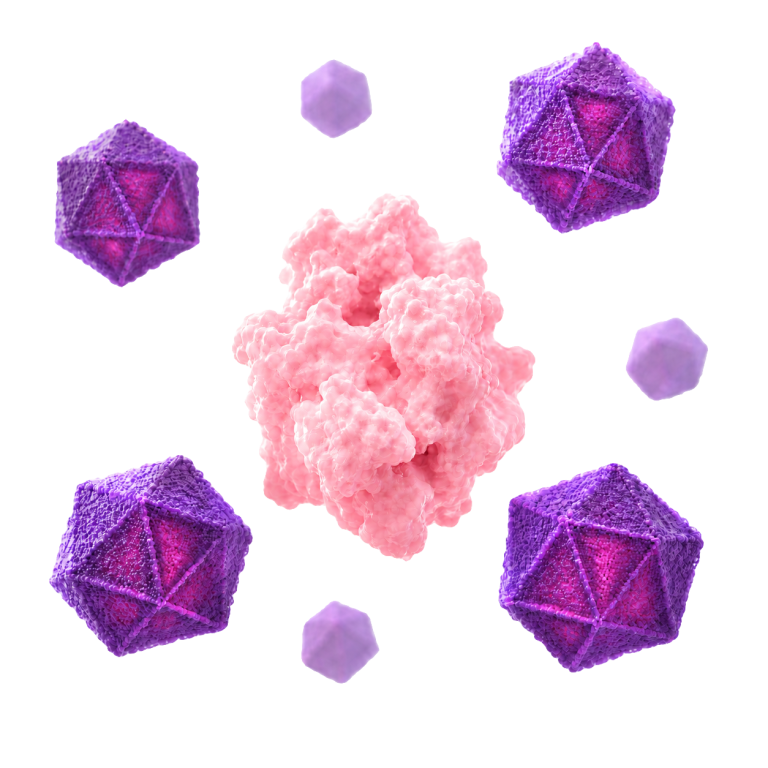
Impurity burden can affect the process before final purity is measured.
Viral vector process streams can contain complex mixtures of host cell proteins, residual nucleic acids, chromatin, cellular material and process debris.
These impurities may affect multiple stages of the downstream workflow:
- Affinity resin fouling
- Capture-step recovery
- Pressure and flow behavior
- Polishing requirements
- Batch-to-batch consistency
Broad-spectrum polishing technologies can reduce impurity burden, but viral vector purification requires a careful balance between clearance and recovery. The process must remove smaller contaminants without unnecessarily binding, retaining or losing the vector.
Where Current HCP Clearance Strategies Fall Short
Existing approaches to HCP management in AAV purification have four compounding limitations.
01
Non-Selective Polishing Leaves Residual HCPs
02
HCP Fouling Limits Affinity Resin Lifetime
03
Upstream Variability Compounds Downstream Complexity
04
Process Economics Require a Better Approach
Purpose-Designed, Affinity-Driven Impurity Control
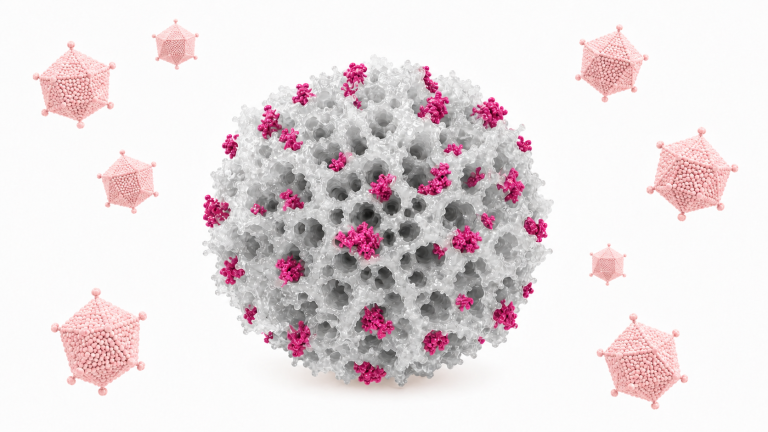
Our unique flow-through impurity-control approach combines a synthetic peptide affinity ligand ensemble with a porous, hydrophilic resin matrix.
Exploiting the size difference between viral vectors and smaller process-related contaminants the porous shell excludes large viral vector particles from entering the resin core. Smaller HCPs and nucleic-acid-associated impurities can access the core, where they bind to the HCP-affinity ligand ensemble. The outcome is targeted impurity reduction while the viral vector remains in the product flow.
Protect Affinity Capture Resin
Reducing HCP, DNA and process-debris burden before capture may help limit fouling and support more consistent affinity-resin performance.
Preserve Vector Recovery
The flow-through design is intended to reduce impurity burden without making the viral vector the binding target.
Reduce Polishing Pressure
More selective impurity control may reduce the burden placed on later polishing steps and simplify the clearance strategy.
Improve Process Consistency
Better control of the feed entering or leaving affinity capture may improve recovery consistency and downstream reproducibility.
This application falls under our NAVIGATE program, connecting you with process expertise, new purification technologies, new insights and collabration opportunities to shape and implement a GMP-ready solution.

Moving Beyond Non-Selective Polishing: Reproducible, Proteomics-Informed HCP Clearance for Viral Vector Processes
Evaluating AAV capture? Discover AvXcelTM
Our serotype-agnostic, alkaline-stable AAV affinity resin with flexible elution properties for higher recovery and preserved viral activity.
Get in touch with us today.
Whether you’re exploring purification solutions, have a technical question, or want to learn more about our technologies, we’re here to help. Complete the form and a member of our team will be in touch shortly.