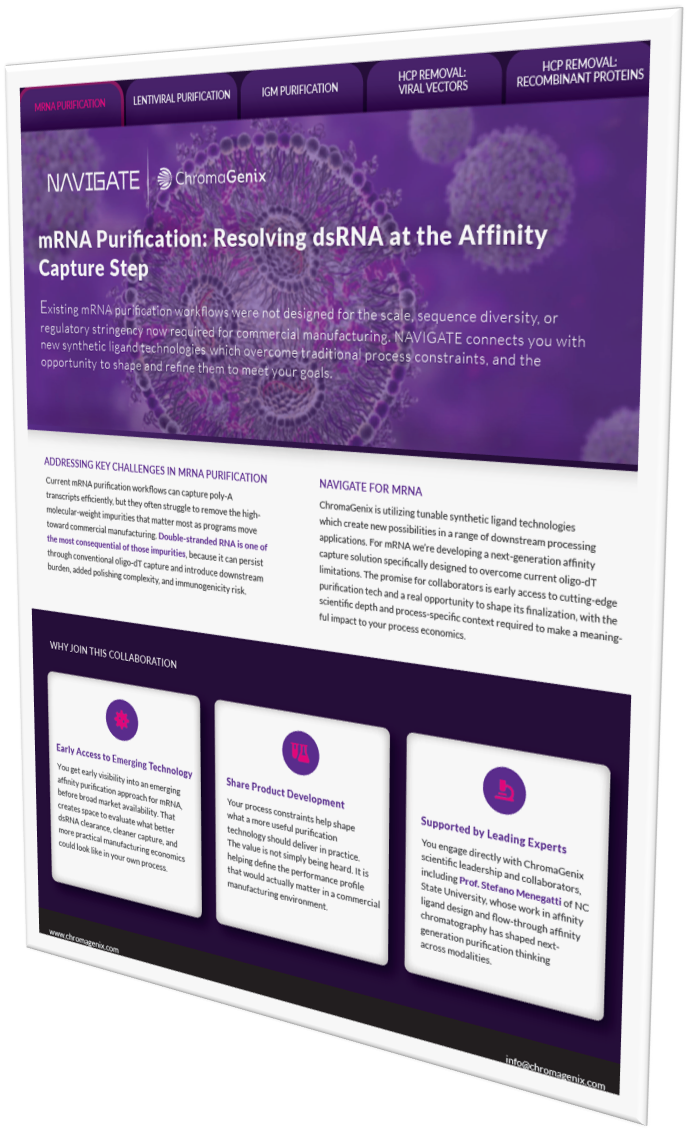
mRNA Purification: Resolving dsRNA at the Affinity Capture Step
The full figure set, development data and process rationale, drawn from peer-reviewed work across four independent CHO feeds. Complete the short form to download the PDF.
Bind-and-elute capture profile: A clean 260 nm chromatogram confirming mRNA is retained on the adsorbent, not flowing through..
dsRNA / mRNA separation overlay: The two species resolving as distinct peaks under identical gradient conditions.
Head-to-head vs oligo-dT: Side-by-side gel showing HMW impurities cleared in the ChromaGenix eluate but persisting in oligo-dT.
dsRNA dot blot evidence: Antibody-based detection showing strong dsRNA depletion in the eluate.
Combined ChromaGenix + PrimaS workflow: Near-complete dsRNA clearance reproduced across a CRISPR Cas9 construct.
PROGRAM CHAIR
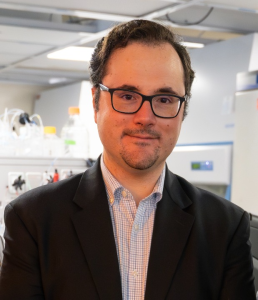
Professor Stefano Menegatti
NORTH CAROLINA STATE UNIVERSITY | CHROMAGENIX
Why this session exists
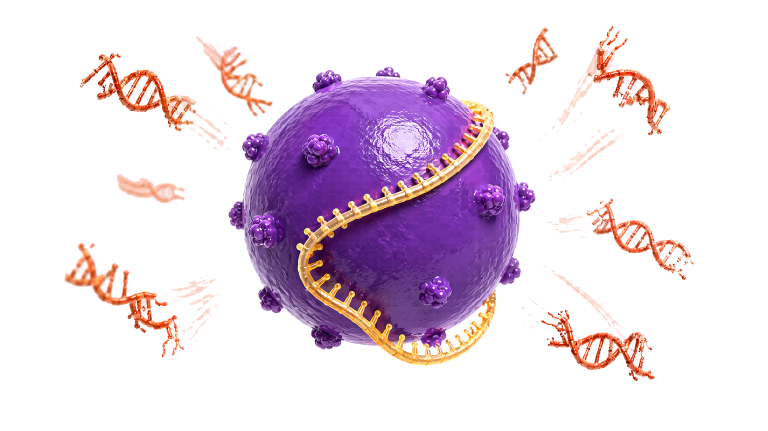
Existing mRNA purification workflows were not designed for the scale, sequence diversity or regulatory stringency now required for commercial manufacturing. Oligo-dT captures poly-A transcript efficiently, but dsRNA can persist through it, adding polishing complexity, immunogenicity risk and downstream burden.
The ChromaGenix approach
ChromaGenix is developing a next-generation affinity capture solution designed to overcome current oligo-dT limitations. Its PePNA ligands bind mRNA via nucleobase interactions rather than the poly-A tail — and bind mRNA, not DNA — resolving dsRNA and mRNA as distinct chromatographic species and creating potential for broader construct compatibility and stronger front-end impurity clearance.
Data Demonstrates That dsRNA Can Be Resolved at the Primary Affinity Capture Step
The following key conclusions were drawn from peer-reviewed studies conducted at ChromaGenix and NC State University.
dsRNA separates from mRNA at primary capture
ChromaGenix ligands resolve dsRNA and mRNA as distinct chromatographic species, supporting more robust front-end impurity clearance.
Cross-construct performance supports a platform
dsRNA was reduced toward near-LOQ across multiple mRNA constructs, including CRISPR Cas9 — indicating a mechanism that is not sequence-dependent.
Cleaner eluate than conventional oligo-dT
Head-to-head gel and dot blot data show substantially lower dsRNA and high-molecular-weight impurity burden in the ChromaGenix ligand eluate.
The workflow is operationally viable
Chromatograms show clean bind-and-elute performance under controlled conditions, with efficient product recovery.
A Capture Workflow Designed to Remove More Burden Up Front
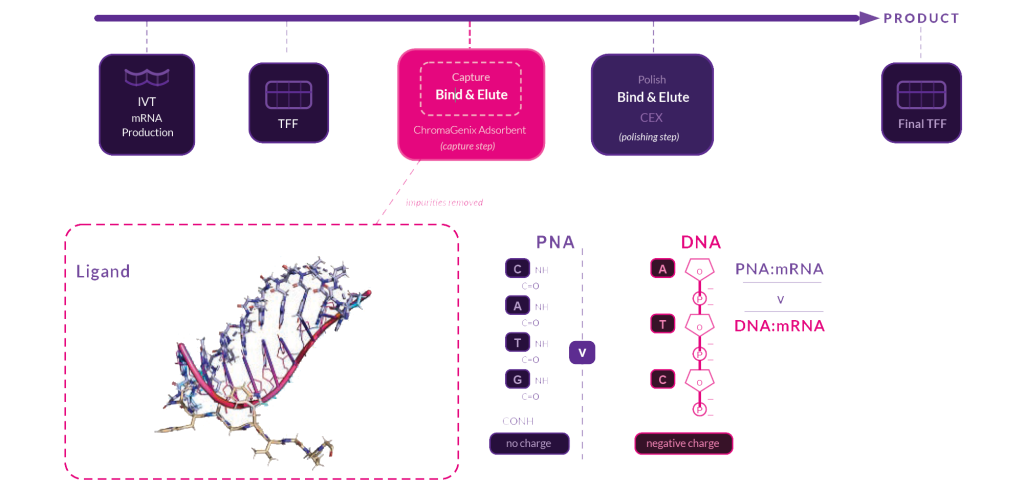
The ChromaGenix ligand capture step sits between TFF and a polishing CEX step, operating in bind-and-elute mode.
Our ligands bind mRNA via nucleobase interactions rather than relying on the poly-A tail, making them applicable to mRNA constructs regardless of sequence or tail length.
The key selectivity principle is that the ChromaGenix ligand binds mRNA and not DNA. This creates the potential for broader construct compatibility and improved impurity discrimination compared with con ventional oligo-dT capture
mRNA Purification: Resolving dsRNA at the Affinity Capture Step
Review emerging technology direction before release.
Direct product input
Help define the performance thresholds, process conditions, analytical readouts and GMP-readiness expectations that would make a future product useful.
Scientist-led discussion
Engage with ChromaGenix technical teams on the process problem, not a generic sales pitch.
Potential evaluation pathway
Where there is technical fit, discussion may progress toward deeper data review, Product Focus Group participation, prototype evaluation or collaboration.
What you can expect
01
Scoping conversation
A brief discussion to confirm fit, context and the scientific value of collaboration.
02
Defined collaboration
A structured technical discussion with ChromaGenix process scientists, grounded in your process context to identify constraints and potential solutions.
03
Ongoing development
Continued engagement to support development, testing and refinement toward a better purification solution, shaped by what you have shared.
Why wait for better purification tools when you can help shape them?
Join NAVIGATE as an early adopter. Test new resins with your own feedstock, access pre-commercial data, and be first to know when products launch.
Complete the form and a member of our team will be in touch shortly.
Chris is responsible for identifying investment opportunities, assessing strategic fit within the portfolio, and supporting growth-related operational initiatives. A serial entrepreneur with over 20 years of bioprocessing experience, he has deep expertise across upstream and downstream technologies. Prior to BioProcess360, he founded and led the Purolite Bioprocessing division, growing it from zero revenue in 2015 to $80M in six years. The business was acquired by Ecolab (NYSE: ECL) in 2021 for $3.7BN. Earlier, Chris helped pioneer single-use technology at WAVE Bioreactors, later acquired by GE Healthcare (now Cytiva), and held senior roles at GE and Merck Millipore. He holds an MSc in Biotechnology and attended Harvard Business School. Outside work, Chris enjoys biking, paddleboarding, live music, and spending time with his two daughters.